
Share this
by Tee Dang Mankiewicz on Apr 6, 2026 1:08:05 PM
Cognitive bandwidth is one of the most exhausted resources in the modern corporate landscape. As decision-makers race to upskill a global workforce, they are experiencing a sobering reality: the traditional, marathon-style training seminar has become a bottleneck. Welcome to the age of microlearning, where the competitive advantage belongs to those who can transform minutes of distraction into milestones of mastery.
According to industry benchmarks, the average employee has only 1% of their workweek dedicated to professional development. In a standard 40-hour week, that equates to a meager 24 minutes. When you juxtapose those 24 minutes against traditional day-long seminars or two-hour e-learning marathons, the disconnect is glaring.
Modern organizations live in an “Attention Economy” where pings, meetings, and immediate deliverables compete for cognitive space. To keep the competitive edge, organizations must stop fighting for more of the employee’s time and start making better use of the seconds they actually have.
To comprehend the training solution, we must first answer: What is Microlearning? At its core, microlearning is an instructional design strategy that breaks complex topics into short, focused chunks of information, typically ranging from 2 to 7 minutes. While traditional macro-learning is like a five-hour course: heavy, time-consuming, and hard to retain all at once, microlearning is the recommended strategy that provides an immediate reinforcement exactly when the frontline workers are looking for it.
Microlearning is often mistaken for a mere “Gen Z” trend or a byproduct of diminishing attention spans. In reality, it is a sophisticated response to the way the human brain naturally processes information. As we look forward to Sales Enablement, it is clear that the future of work requires agility.
Microlearning is the only scalable way to build a high-performance workforce with the right LMS. It bridges the gap between knowing and doing, transforming training from an annual “event” into a continuous, integrated part of the workday. By prioritizing the 5 benefits you’ll explore in this guide, companies can finally move past the “check-the-box” mindset and drive real, measurable behavioral change.

The 5 Benefits of Microlearning in Corporate Training

The transition from traditional, monotonous training to a microlearning framework is more than a tactical shift; it is a strategic alignment with the neurological and operational realities of the 2026 organization. As organizations grapple with the complexities of Skill development for frontline teams and rapid depreciation of technical knowledge, the “one-and-done” workshop model has proven insufficient. It creates a barrier where information is delivered in bulk but applied in fragments.
Microlearning solves this by deconstructing macro-concepts into high-impact, single-objective modules. This precision allows leadership to map training directly to the Key Corporate LMS Features for Next-Level Employee Training, ensuring that every minute an employee spends in the digital classroom yields a measurable return on investment. By focusing on brevity, accessibility, and cognitive ease, microlearning transforms professional development from a disruptive obligation into a seamless flow of work.
Whether you’re looking to refine commitment conversations in the workplace or seeking the best LMS for onboarding, the following five benefits explain why microlearning is the catalyst for modern organizational performance. These advantages go beyond simple convenience; they redefine how knowledge is internalized, retained, and ultimately turned into a competitive edge.
Benefit 1: Drastically Improved Knowledge Retention
The most important rubric to track the effectiveness of any corporate training program is how much of that information actually translates into on-the-job performance weeks later. Traditional training models suffer from the “forgetting curve”: pouring vast amounts of data into an employee’s mind, only for most of it to drain away before it can be applied. Microlearning addresses the gap by aligning the training with the Laws of Learning.
To understand the impact of microlearning, we must first look at the Forgetting Curve, a concept pioneered by psychologist Hermann Ebbinghaus. His research demonstrated a sobering reality: humans forget approximately 50% of new information within an hour of learning it and up to 80% if that information isn’t reinforced.
In a “macro” training environment such as a four-hour compliance seminar or a marathon session on Technical Training for Caregivers, the brain is hit with a tidal wave of data because the volume is so high and the delivery is a one-time event, the brain categorizes the bulk of it as “noise” rather than “signal,” leading to rapid informational decay. This is why employees often leave intensive workshops feeling inspired but unable to recall specific protocols just days later.
Microlearning serves as the perfect vehicle for Spaced Repetition, a learning technique that involves reviewing information at increasing intervals. By breaking a complex theme into five-minute micromodules, you can prompt an employee to revisit a core concept exactly when the Forgetting Curve starts to dip. The goal of an effective spaced learning program is to interrupt the forgetting process. Instead of one overwhelming training initiative, a modern business LMS can push a micro-lesson on Monday, a quick quiz on Wednesday, and a real-world application scenario on Friday.
Each interaction strengthens the neural pathways, moving the information from short-term working memory into long-term storage. The architectural approach to learning ensures that the Law of Exercise and Law of Effect are working in your favor.
Navigating Cognitive Load Theory
The human brain has a limited capacity for processing new information at any given moment, a concept known as Cognitive Load Theory. When we overwhelm an employee with too many variables at once, they are overwhelmed. The brain effectively shuts down to protect itself from burnout, leading to frustration and disengagement.
Microlearning acknowledges these limits. By delivering bite-sized information, you provide just enough information for the brain to process and “file away” before moving to the next task. This is particularly critical when tackling complex behavioral changes, such as leading commitment conversations in the workplace. Asking a manager to learn ten different conflict-resolution frameworks in one sitting is a recipe for failure. Asking them to master one five-minute technique for active listening, however, is achievable and sustainable.
Strengthening the Physiological Basis of Retention
At a physiological level, learning is the creation of synapses. Thickening these connections requires consistent, low-stress simulation. By utilizing key corporate LMS features such as push notifications for micro-content, you provide the brain with the repetitive “pulses” it needs to solidify these connections.
In the context of Sales Enablement, this means a sales rep doesn’t just read a manual on buyer personas once a year. Instead, they receive a three-minute micro-lesson on how to use DISC in sales right before a high-stakes call. The proximity of the learning to the application, combined wth the reduced cognitive load, results in a level of retention that traditional “macro” programs simply cannot match. This isn’t just training; it's cognitive optimization.

Benefit 2: Boosting Completion Rates & Employee Engagement
One of the most persistent frustrations for L&D professionals is the “ghost town” effect: spending months developing a robust training curriculum only to see a 20% completion rate. When training feels like a mountain, employees tend to stay at base camp. Microlearning changes the course of professional development, transforming the daunting mountain into a series of manageable, rewarding steps.
The “Quick Win” Psychology
At the heart of engagement lies a fundamental neurochemical process. Every time we complete a task, our brain releases dopamine, the “reward” neurotransmitter. Traditional long-form courses delay this gratification; the “win” only comes after sixty minutes of sitting still.
Microlearning exploits the psychology of the “quick win.” When an employee completes a five-minute module on best onboarding practices, they receive an immediate hit of satisfaction. This creates a positive feedback loop because the barrier to entry is so low that the brain perceives the task as “low cost/high reward,” making the employee significantly more likely to click on the next module. You aren’t just teaching them; you are cognitively “hooking” them into a habit of continuous improvement.
When training is broken down, it ceases to be a disruptive event that requires clearing one’s calendar. Instead, it becomes something that can be squeezed into the “in-between” moments of a workday, waiting for a meeting to start, riding an elevator, or during a coffee break. By making learning frictionless, you remove the most common excuse for non-completion: “I simply didn’t have the time.”
Mobile-First Learning to Improve Training Outcomes
The delivery mechanism is just as critical as the content itself. In 2026, the desktop-only LMS is a relic. To maximize engagement, micro-content must live where your employees live: on their smartphones. This is precisely why the Mobile Learning platforms are an essential vehicle for modern training.
Mobile-first microlearning allows for “Point-of-Need” access. A retail manager facing a difficult staff situation can quickly pull up a two-minute refresher on toxic employees and how to handle them, right from the sales floor. This relevance drives engagement because the employee sees the immediate utility of the information. When training solves a problem in real-time, completion rates soar because the learner is pull-driven rather than push-mandated.
Gamification: Turning Modules into Milestones
Micro-modules are the perfect building blocks for a gamified ecosystem. Because the segments are short, they can easily be attached to a points system, leaderboards, or digital badges without feeling gimmicky. Integrating these into your LMS creates a sense of healthy competition and progression.
For instance, a sales team could compete to see who completes the DISC in Sales series first, earning a communication master badge. This layer of social proof and gamified progress transforms the solitary act of learning into a collective, engaging experience. By leveraging these triggers, you don’t just ask for an employee’s attention; you earn it.
Benefit 3: Speed of Development and Deployment
In the hyper-accelerated corporate culture, the traditional “waterfall” approach to training development is a liability. By the time a comprehensive, 40-module certification program is researched, scripted, filmed, and deployed, the industry standards it covers have often already shifted. Microlearning offers the agility required to keep pace with the speed of business, allowing L&D teams to deploy critical updates in hours rather than months.
Agility is the primary differentiator between market leaders and those left behind. Whether it’s a sudden shift in Sales Enablement or an updated compliance regulation for HHA in service training, organizations cannot afford a three-month lag in knowledge transfer. Microlearning allows for “Just-in-time” deployment. Because the content is modular, you don’t need to rebuild an entire curriculum to address a single change.
You simply swap out or add a 3-minute video or a 5-question quiz. This modularity ensures your workforce is always operating on the most current data, turning your training department from a slow-moving cost center into a rapid-response unit.
The most significant catalyst is the integration of Artificial Intelligence within the LMS. Understanding AI course building is now a prerequisite for efficient management. These tools have revolutionized the content creation pipeline. Instead of an instructional designer spending weeks deconstructing a 100-page SOP manual, they can now use AI to ingest the document and automatically generate a series of high-impact micro-lessons.
Learning AI-based course creation allows teams to transform dry, technical documentation into engaging, interactive modules in minutes. This is particularly vital for technical training, where new medical protocols must be disseminated to frontline staff instantly to ensure patient safety and regulatory compliance.
Traditional training is plagued by the “Sunk Cost” fallacy. Companies invest thousands of dollars into a massive 4-hour seminar or a high-production value feature film for onboarding. When a single policy changes six months later, that entire investment is effectively rendered obsolete or worse, spreads misinformation. Microlearning is inherently more cost-effective because it is iterative.
The cost of producing a 5-minute module is a fraction of a full-scale production. Furthermore, maintenance costs are drastically lower. If you need to update a strategy, you only edit the specific micro-segment affected. For those looking for the low-cost, high-speed approach, the only way to compete with enterprise-level budgets while maintaining a world-class training standard.
Rapid Deployment for Frontline Impact
For industries with high turnover or rapid scaling needs, such as home care, speed is everything. By utilizing microlearning course builders, a manager can identify a performance gap in the morning and have a corrective micro-training pushed to every employee’s mobile device by the afternoon. This level of responsiveness doesn’t just improve skills; it protects the bottom line by ensuring that workforce development is a continuous, real-time process rather than a scheduled annual event.
Benefit 4: Precise Targeting of Skill Gaps
Traditional corporate training often follows a “spray and pray” pedagogy: everyone sits through the same three-hour session, regardless of their existing expertise or specific weaknesses. This creates a massive inefficiency where high performers are bored by redundant information and struggling employees are overwhelmed by content that doesn’t address their specific hurdles. Microlearning flips the script, allowing for a surgical approach to skill development for frontline teams.
Just-in-Time Training vs. “Just-in-Case” Learning
The shift to microlearning represents a transition from “Just-in-Case” learning, where employees are taught a broad array of skills they might need one day, to “Just-in-Time” learning. The latter provides the specific solution to the exact moment the problem arises. In a high-pressure environment, “learning for later” is often forgotten before “later” ever arrives. By contrast, “learning for right now” has a high utility value.
When a technician is standing in front of a complex piece of machinery and needs to remember a specific safety protocol, they don’t need a 40-minute course on the history of safety; they need a 60-second micro-video on that specific valve. This proximity between learning and doing is what transforms LMS from a list of features into a strategic performance tool.
To maximize the impact of micro-content, organizations must first perform a skill gap analysis. By identifying exactly where an individual or team is falling short of KPIs, L&D managers can move away from general training tracks and toward personalized “perceptions.”
If an analysis reveals that a middle manager is effective at operations but struggles with interpersonal conflict, the LMS shouldn’t assign them a full “Management 101” course. Instead, it should push a targeted microlearning path focusing on coaching and commitment conversations. The following diagnostic approach ensures that no time is wasted on what the employee already knows, focusing 100% of their limited “1% learning time” on the areas that will drive the most growth.
Personalization through Learning Analytics
An impactful Learning Management System does more than just host content; it acts as an intelligent coach. By leveraging Predictive Insights, the system can track patterns in employee performance and suggest micro-interventions before a gap becomes a crisis. For instance, if the data shows an employee is consistently failing quizzes related to a specific compliance area, the system can automatically trigger a reinforcement on the best compliance courses for caregivers.
The level of personalization creates a bespoke learning journey for every employee of the organization, ensuring that the corporate LMSs aren’t just libraries of content but active participants in employee development. To see the benefit in action, consider a senior account executive preparing for a major closing call. They don’t have time to re-read a textbook on sales psychology. However, they do have time to spend three minutes on their mobile device reviewing the DISC sales call content.
By quickly identifying that their prospect has a “Dominant” personality type, the rep can immediately adjust their tone and strategy. This is microlearning at its most potent: a high-impact, highly-relevant “cheat sheet” delivered in the flow of work. When you can target skill gaps with this level of precision, you aren’t just training your staff; you are giving them a real-time competitive advantage that directly impacts the bottom line.
Benefit 5: Supporting Diversity, Equity, and Inclusion (DEI)
In the modern corporate era, DEI is no longer a peripheral HR initiative; it is a core pillar of operational excellence. However, traditional DEI training often fails because it relies on infrequent, high-intensity workshops that can feel performative or overwhelming. Microlearning offers a more organic, sustainable way to weave equity into the fabric of the organization, ensuring that workplace diversity is an actionable reality rather than a corporate slogan.
Accessible and Neurologically Diverse Training Programs
Standard “macro” training often favors a specific type of learner, typically those who can sit still and process long strings of auditory or written information for hours. This “one-size-fits-all” approach creates unintentional barriers for neurodivergent employees, such as those with ADHD, dyslexia, or sensory processing differences.
Microlearning is inherently more accessible. By providing short, captioned videos, interactive infographics, and text-based summaries, you cater to a variety of learning styles. A five-minute module allows a neurodivergent employee to focus intensely without the fatigue of a two-hour lecture. The varied format ensures that different learning strategies are implemented to improve organizational performance, allowing every mind in the building to contribute at its highest capacity.
Inclusive Onboarding
The most critical window for fostering a sense of belonging is a new hire’s first three months. Rather than dumping an entire culture handbook on a recruit on Day 1, microlearning allows for bite-sized information on cultures and values.
The goal of inclusive onboarding is to drip-feed essential cultural nuances. A new hire might receive a three-minute video on the company’s pronoun policy on Tuesday, followed by a micro-lesson on how to use the “raise hand” feature in meetings for equitable participation on Thursday. This gradual integration helps employees feel seen and supported from the start, significantly impacting employee retention, engagement, and outcomes
Reduce Cognitive Bias via Micro-Nudges
Unconscious bias is not a problem that can be solved with a once-a-year compliance check. Bias is a habit of the mind, and habits are broken through consistent, small interventions. Microlearning enables the use of micro-nudges: brief, frequent reminders of inclusive behavior delivered directly into the workflow.
For instance, before a manager begins a hiring cycle, the LMS can push a two-minute refresher on best recruitment practices with a specific focus on mitigating interview bias. This “just-in-time” nudge is far more effective than a training session the manager attended six months ago. By keeping these concepts at the forefront of the mind, microlearning helps move the needle on diversity in the workplace, turning abstract inclusive values into daily inclusive actions.
Building a Culture of Continuous Equity
When DEI is integrated into the daily learning habit, it ceases to be a “special event” and becomes “how we work.” By utilizing a corporate LMS, leadership can ensure that diversity training is as regular and accessible as a sales update or a technical refresher. This consistency builds trust and demonstrates a genuine, long-term commitment to equity, which is the ultimate foundation of a high-performance workforce.
Microlearning for Frontline & Caregivers

In high-stakes environments like home care and healthcare, the “classroom” is often a patient’s bedside or a moving vehicle. Frontline workers experience a unique set of hurdles, including erratic schedules and high-stress responsibilities that make traditional desk-based training impossible. The primary barrier to the development of frontline workers is the physical and temporal disconnect between the office and the field.
Microlearning bridges the gap by turning the smartphone into a real-time clinical assistant. For those undergoing technical training, a five-minute video on proper lift techniques or wound care is far more effective when viewed immediately before a shift than a lecture attended three months prior. Similarly, maintaining compliance through HHA in-service training becomes a seamless process when hours are broken into bite-sized learning segments.
By leveraging the best LMS for caregiver agencies, providers can ensure that critical safety protocols and best compliance courses are always at their fingertips. This mobile-first, bite-sized approach doesn’t just improve scores, it saves lives by ensuring that the right knowledge is available at the exact moment of care.
Best Practices for Implementation of Microlearning Programs
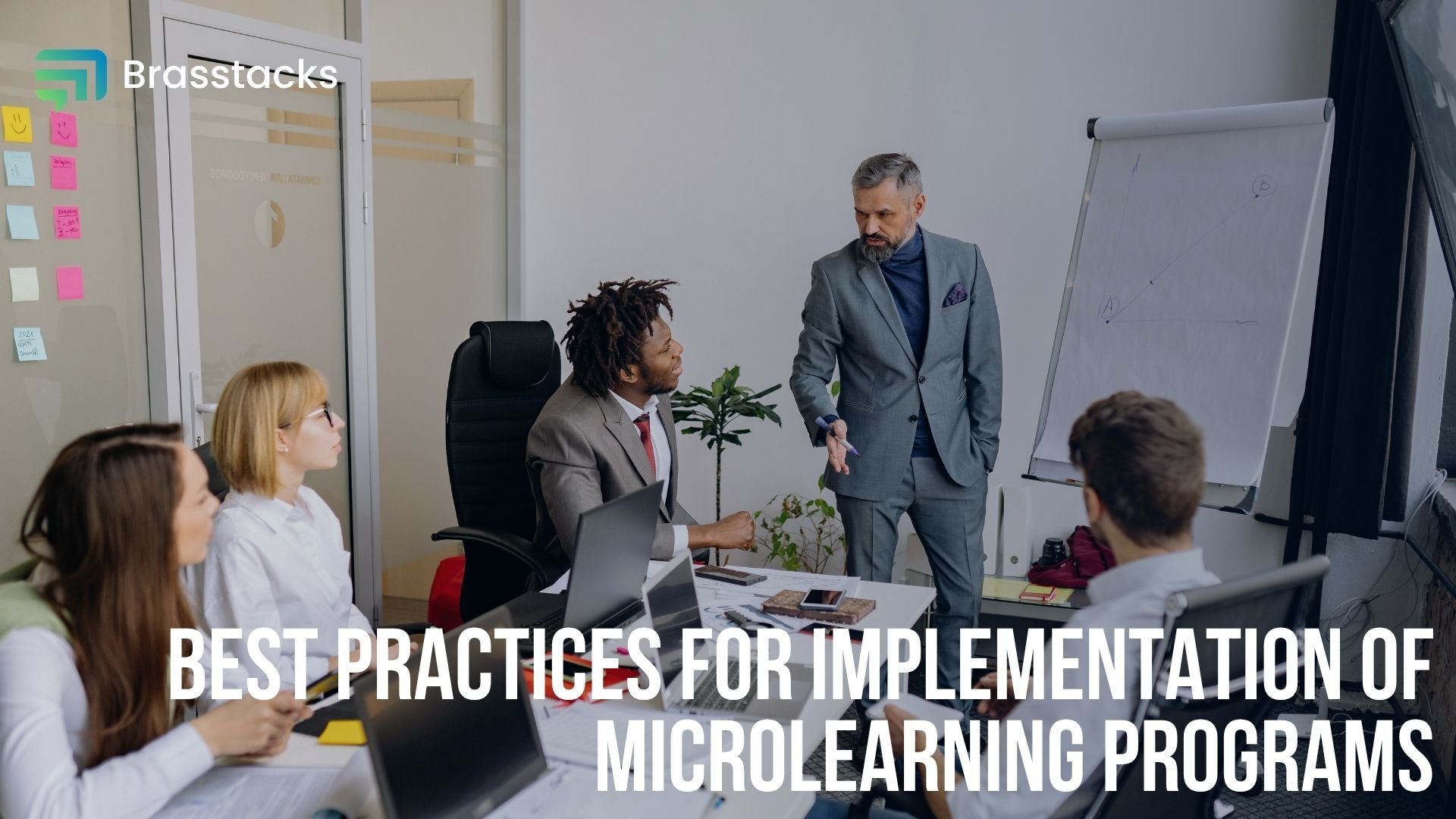
Successful microlearning requires more than just segmenting long-form content; it demands intentional design. Avoid the “chainsaw method,” simply chopping up old webinars often results in fragmented, confusing lessons. Instead, curate content specifically for the bite-sized format, ensuring each module has a singular, actionable objective.
The selection of infrastructure is equally vital. Consult our LMS comparison guide to find platforms that support mobile-first delivery and robust learning analytics and predictive insights. Utilizing the microlearning course builders can further streamline the process and accelerate course creation. Finally, encourage employees to use time management techniques to dedicate small, intentional windows for these modules, ensuring development becomes a seamless part of their daily workflow rather than an afterthought.
FAQs
Is microlearning more effective than traditional corporate training programs for long-term retention?
Absolutely, while traditional “macro” sessions often lead to information overload, microlearning specifically targets the forgetting curve. By delivering content in 3-to-7-minute bursts, it respects the brain’s natural cognitive limits. When combined with spaced learning programs, microlearning reinforces neural pathways over time, leading to significantly higher long-term retention rates than one-off, day-long seminars.
How does microlearning help in achieving high completion rates?
The primary reason for low engagement in corporate training is the scarcity of time. Microlearning removes the friction of scheduling by allowing employees to learn in the “flow of work.” By hitting the “quick win” psychological trigger, employees feel a sense of accomplishment more frequently. This is why organizations using microlearning strategies see a dramatic shift from forced compliance to voluntary, habit-based learning.
Can microlearning be used for complex themes like Sales or Compliance?
Yes, but it requires a modular approach. Rather than teaching “Sales” as a single block, you break it down into specific, actionable micro-skills. For instance, a rep might take a 5-minute module on how to use DISC in sales calls immediately before a meeting, or a caregiver might review a specific protocol via HHA in-service training on their mobile device. This “just-in-time” application ensures that even complex, high-stakes information is delivered exactly when it is most relevant and useful.
Conclusion
As we navigate the complexities of the modern corporate landscape, the mandate for leadership is clear: training must evolve or become obsolete. Microlearning is not merely a “shorter” version of education; it is a fundamental reconfiguration of how knowledge is transferred in a high-velocity world. By prioritizing retention, engagement, speed, precision, and inclusivity, companies can finally dismantle the barriers that have long hindered professional development.
Microlearning serves as the essential bridge between raw employee potential and peak organizational performance. Whether you are refining your sales strategy or looking to reduce employee turnover, the shift to bite-sized content provides the agility necessary to thrive. It moves the needle from passive consumption to active mastery.
Now is the time to audit your current employee training and development strategy, identify the “macro-bloat” that is slowing your team down, and replace it with a leaner, more surgical approach. By embracing the power of small, frequent learning moments, you aren’t just checking a compliance box; you’re building a resilient, future-proof workforce capable of meeting any challenge. Sign up for a demo now!