

Share this
by Tee Dang Mankiewicz on Oct 8, 2026, 5:32:00 AM
Think about a caregiver’s random Tuesday. They are up before six, drive to a client’s home across town, help with a bath and meds, then head to a second visit after a gap that’s too short to go home and too long to sit idle. Their phone is the one screen she has with her all day. Now picture asking her to log into a desktop portal and sit through a 45-minute course. That’s the mismatch most home care training programs are built around; that's why mobile training works.
So training gets assigned, and then it is left incomplete. Reminders pile up, and managers chase people, and everyone assumes training programs are effective. Then audit season arrives, and the gaps start to surface: an expired certification here, a missing in-service record, or a dementia care module nobody opened. Misinformed training delivery leads to low completion rates and poor outcomes.
The guide compares the best text-based microlearning platforms on three things that matter to agencies:
- Operational fit: Does training connect to scheduling and the rest of how you run the agency? How does LMS integration tie training to scheduling?
- Compliance: Can you attest to who completed what, and track recertification and expirations before they become operational deficiencies?
- Delivery friction: How many taps stand between a caregiver and the lesson? What’s slowing caregivers down?
Brasstacks is a premium and frictionless text-based microlearning platform that enhances your organizational compliance and adherence. This guide will help the training managers, agency owners, and clinical directors who are tired of chasing completions and want a system that works for caregivers as they actually work. If you’re looking for healthcare agency learning management software, you’ve come to the right place.
How Text-Based Microlearning Helps Caregivers
Text-based microlearning means short lessons, usually a few minutes long, sent through SMS, a messaging app, or a mobile delivery. A caregiver gets one idea, answers a quick question, and moves on. There’s no portal to remember and no course to block out an hour for. It leads to effective time management and learning outcomes.
The format helps the caregivers accomplish the training objectives and improve their performance. Text-driven learning moments are helpful in retaining knowledge longer and acting on it faster. Brasstacks LMS makes a similar case for frontline staff. SMS delivery skips the desktop, the stable internet connection, and the scheduled session that traditional LMS courses often assume. For on-the-go caregivers, it differentiates between finishing a lesson and putting it off.
The Benefits of Text-Based Microlearning
- Accessible Reach: A text arrives on any phone, so there’s nothing to install and no password to forget, leading to a frictionless learning experience.
- Repetition: Bite-sized, regular lessons suit refreshers on infection control, safe transfers, or dementia communication, which caregivers need to practice often.
- Speed: When a policy changes, you can push a short update this week instead of building a full course.
- Manager Visibility: Quick completions and quiz answers show who’s keeping up before an audit does.
Texts can’t replace everything. Hands-on skills, like safe patient handling or medication administration, still need in-person demonstrations and competency checks. Regulators also set their own rules on seat time, documentation, and accepted formats. Check what your state and accrediting bodies allow before you move required in-service hours to a text format.
Some vendors say shorter, mobile-first modules improve completion and retention in healthcare training. Treat that as a vendor claim and look for independent data before you promise your board a specific outcome. So the best training program has a blended approach: microlearning for steady reinforcement and reminders, with a fuller LMS for longer courses and records.
How We Evaluated the Different Text-Based Microlearning Platforms

Every text-based microlearning platform is assessed against the same seven criteria, so the comparison stays fair. We built the scorecard around two questions: what does a training manager have to defend in an audit? What does a caregiver have to put up with on a busy day? Our buyer’s guide takes a similar approach and puts compliance as our priority.
|
Criterion |
What we looked for |
|
Compliance |
Automated assignment, recertification tracking, expiration alerts, and audit-ready reports |
|
Operational Fit |
Links to scheduling, HR, or payroll, so training status can affect who gets assigned to shifts and which learning paths |
|
Frictionless Delivery |
Whether caregivers need an app or login, and whether it works on any phone or offline |
|
Content |
Pre-built library, room to customize, and state-specific courses |
|
Security |
HIPAA alignment, personalized access, and audit logs |
|
Reporting |
How quickly you can pull completion records for the auditor |
|
Cost and Customer Support |
Pricing Model, Setup time, and Quality for help. |
The Essential Ranking Factors
Compliance, operational fit, and delivery friction drive the ranking. A platform with a huge course library still fails if caregivers won’t access it. An LMS that’s easy to use still struggles if you can’t produce records when a surveyor asks.
Operational fit is one of the most underrated ranking factors. When training status connects to scheduling, an expired certification stops being a spreadsheet problem. The system catches it before a shift is assigned. Brasstacks, for example, holds back scheduling eligibility until required training is current.
Delivery friction deserves the same attention. Every extra login, download, or password reset gives a tired caregiver a reason to skip the lesson. Text-based tools tend to score well here because they reach people on the phone they already carry.
How to Read Our Rankings?
We’ve pulled together these rankings by looking at what vendors publish, what independent buyer’s guides say, and what real users report online. Consider the following listicle as the starting point. It is meant to help you narrow the field and make an informed decision.
Every organization has unique needs. What works for a 50-person agency might be irrelevant for a small organization with 5-10 employees. Moreover, demo it before you buy it. The feature on the sales page? Ask the vendor to walk you through a real completion report and an expiration alert during the demo. A live demonstration tells you far more than any marketing sheet ever could.
Use these rankings to build your shortlist. Then, talk to the vendors. Ask the tough questions. See the software in action. The right platform for your team is the one that makes training easier and aligned with your organizational objectives.
Quick Comparison Table of the Best Text-Based Microlearning Platforms for Home Care Agencies
Here's the shortlist at a glance. Use it to narrow your options, then read the full reviews below before you book a demo.
5 Best Text-Based Microlearning Platforms for Home Care Agencies
Every home care agency has different kinds of training requirements. Some need caregivers to finish a lesson in five minutes on their own phones. Others need training that locks into scheduling, or a full compliance suite for audits across several sites. Here are five platforms to improve the service and content delivery for better completion rates. Each is reviewed based on key features, compliance strengths, limitations, and pricing.
Brasstacks LMS - The Premium Text-Based Microlearning Platform
Best for: Agencies that want caregivers to complete training without an app, a login, or a desktop.
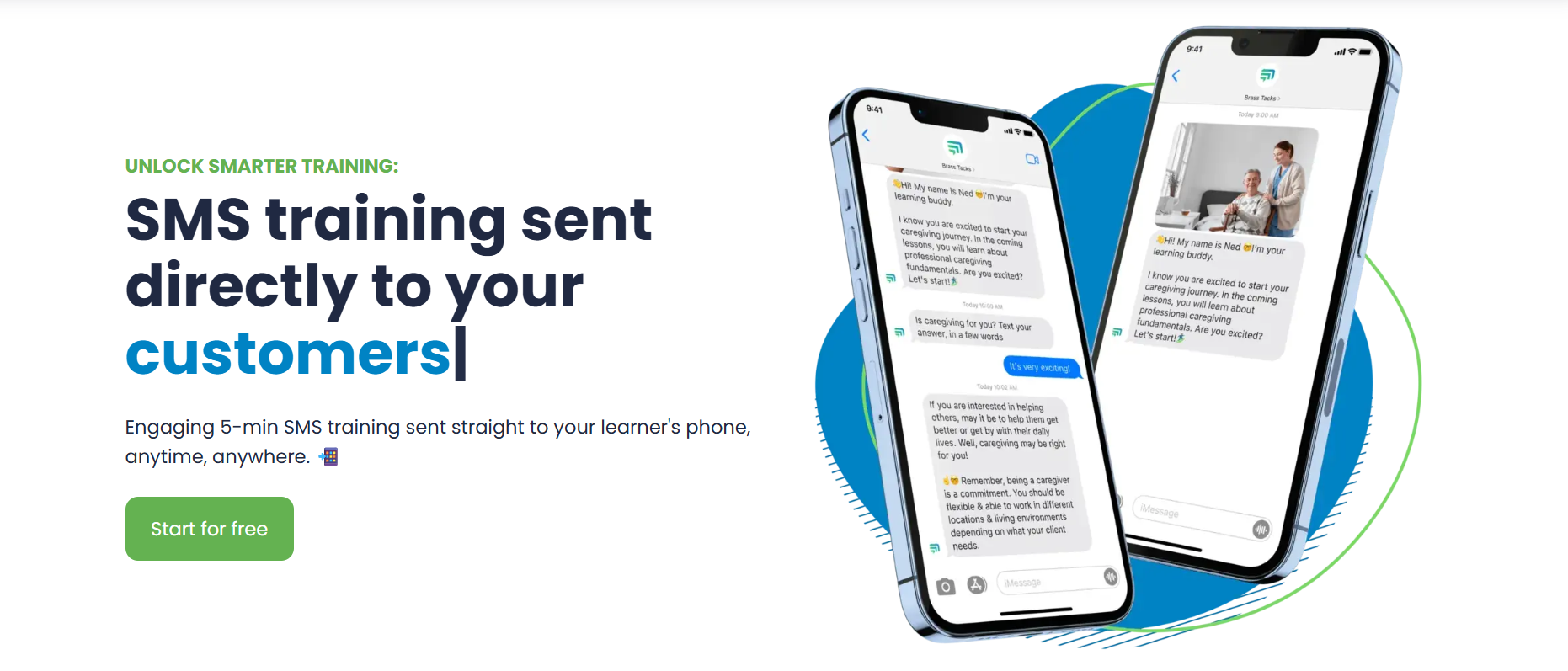
Brasstacks sends bite-sized lessons and quizzes by text message, so caregivers don’t need to install anything or remember their credentials. Each lesson takes about five minutes, and the learner only needs a mobile phone. For a caregiver sitting in her car between visits, that’s about as little friction as training gets.
Key Features:
- Frictionless Learner Setup: Add and update learners in a spreadsheet-style editor that supports imports.
- AI-Course Authoring: Drop in a document such as an SOP, and the AI helps turn it into a microlearning course. You can also build courses with no-code tools (Drag and Drop Feature).
- Ready-made Library: It offers more than 300+ state-compliant and industry-specific topics.
- Automated and Personalized Learning Paths: Chain courses into sequences and schedule months of training in a single session.
- Real-time Advanced Analytics: Track engagement as it happens, so you can step in with anyone falling behind.
- Certificates and Re-certification: The system issues branded certificates of completion and re-certifies learners when they expire.
Learning paths and automatic re-certification address the audit-season gap from the introduction. You set up a year of refreshers once, and the system keeps nudging caregivers without a manager chasing them. The AI course builder lets you convert your own policies into lessons quickly instead of waiting on a content team.
Compliance Strengths: Progress monitoring, branded certificates, and expiration-based re-certification give you a paper trail for each caregiver. That suits recurring in-service refreshers and policy reminders, where the main risk is people never getting around to it.
Limitations: It’s a text-first tool, not a full operations platform, so it won’t tie training to scheduling on its own. Hands-on skills like safe transfers still need in-person checks. Ask in a demo how it handles your state’s hour requirements and record retention, and check what “state compliant” covers for your state.
Pricing: We offer a free plan, but the Pro Plan is $9.70 per learner per month. Enterprise is custom.

CareSmartz360 LMS
Recommended for: Agencies already running, or considering, an all-in-one home care software suite.
CareSmartz360 builds training into its home care platform. The library has 230+ online caregiver courses, interactive videos, and AI-guided learning paths. Topics include infection control, dementia, and behavioral health, medication awareness, mobility assistance, and emergency response.
Key features:
- Courses are assigned inside the same system your office uses for caregiver management.
- Reports show assigned vs. completed courses, scores, overdue modules, and team progress.
- Learning paths can adapt to the caregiver, based on the vendor’s AI-guided approach.
Compliance Strengths: The overdue-module view is the most useful piece for a training manager. You can see who’s behind without building a spreadsheet by hand.
Limitations: The course format leans toward longer online modules and videos rather than text-only microlearning. If your priority is the lowest possible friction, test how caregivers actually take the courses on their phones.
Pricing: The vendor prices by active clients, not by user, and asks you to contact them for a quote.
CareBravo
Best for: Medicaid-focused agencies that want training to affect who gets scheduled, not just sit in a report.
CareBravo takes the most straightforward approach on this list. It assigns required training, tracks completion, and holds back scheduling eligibility until training is current. It also flags expirations before they become compliance events. In practice, an expired certification gets caught before a caregiver is sent to a shift.
Key Features:
- Required training is assigned automatically, and completion is tracked.
- Training sits alongside scheduling, billing, EVV, compliance, hiring, and payroll in one platform for Medicaid home care agencies.
- Scheduling eligibility depends on current training.
Compliance Strengths: It is one of the best examples of operational fit. The system enforces the rule instead of relying on a manager to remember it.
Limitations: It’s a full operations platform, not a standalone learning tool. If you only want a better way to deliver training, you’d be buying far more than you need. Switching scheduling and billing systems is also a bigger project than adding an LMS.
Pricing: There’s a plan starting at $250/month. The model differs from per-seat pricing; compare total operating cost rather than the training line alone.
MedTrainer
Recommended for: Multi-site providers and larger organizations with broad compliance needs beyond caregiver training.
MedTrainer brings compliance, credentialing, and learning into one platform. It’s aimed at US healthcare organizations that need documentation for OSHA and HIPAA training, along with policy management. If your agency is also a home health provider with clinical staff, credentialing, and survey readiness may matter as much as caregiver lessons.
Key Features:
- Documentation support for OSHA and HIPAA training.
- Packages that can be bundled or bought as individual products.
- Learning management, credentialing, and advanced compliance tools in one system.
Compliance Strength: When an auditor asks for training records, credentials, and policy acknowledgments, you want them in one place.
Limitations: It’s built for compliance depth, not for text-based program delivery. Smaller agencies may find it more than they need, and the setup takes more effort. Check how deep the home care course library goes, since the search results I found didn’t confirm that.
Pricing: MedTrainer uses custom quotes based on your organization.
CareAcademy
Best for: Agencies that want a ready-made caregiver course library with audit-ready reporting and don’t need the rest of an operations suite.
CareAcademy focuses on caregiver education and state-approved training courses. Its pricing suits home care agencies that need state-mandated compliance training. That focus makes it easier to evaluate than other platforms.
Key features:
- Packages organized by training area such as dementia and home health.
- Reporting at the class level, including incomplete classes per caregiver.
- A co-branded portal with your agency’s URL, login, and certificates.
Compliance Strengths: Incomplete class reporting directly addresses the audit-season problem and tracks the caregivers who’ve completed the training.
Limitations: Caregivers log into a portal, so it carries more friction than a pure SMS tool. Check how it handles mobile use and reminders. The plan structure also includes a one-year minimum contract.
Pricing: Monthly plan starts at $329, with add-ons priced per seat.
Brasstacks wins on friction, and CareBravo is a clear winner in enforcement. CareSmartz360 and CareAcademy sit in the middle with solid course content and reporting, and MedTrainer wins on breadth. Many agencies end up pairing a text-based tool for reminders with one of the others for full courses and records.
How to Select the Microlearning Platform by Agency Type

The right platform depends less on features than on the problem you’re trying to fix. Start with your agency’s size and biggest pain point, then match it to an LMS type.
|
Your situation |
Best-fit approach |
Platforms to look at |
|
Small agency, under 50 caregivers |
SMS microlearning for fast rollout |
Brasstacks |
|
Growing agency with scheduling pain |
Integrated platform that links training to shifts |
CareBravo, CareSmartz360 |
|
Multi-state or multi-service provider |
Compliance-first LMS with credentialing |
MedTrainer |
|
Offline or low-connectivity workforce |
Check each vendor's offline support |
|
|
Hybrid setup |
SMS reminders plus a full LMS for long courses |
Brasstacks plus CareAcademy or MedTrainer |
Small Agencies: Start with a basic LMS
If you have fewer than 50 caregivers, you probably don’t have a dedicated training team. Text-based delivery gets you running quickly, with no app rollout and no passwords to reset. You can add a scalable LMS if the agency grows.
Growing Agencies: Connect Training to Scheduling
Once scheduling becomes the headache, an integrated platform pays off. CareBravo holds back scheduling eligibility until required training is current, so an expired certification gets caught before a shift is assigned. CareSmartz360 keeps courses and caregiver management in one suite.
Franchise Models: Multi-state Providers
Several states and remote setups mean more rules and more paperwork. A compliance-first system like MedTrainer, which combines learning, credentialing, and policy management, keeps those records in one place.
Hybrid Setups
Many agencies don’t pick just one. Use text messages for reminders and refreshers, and a full LMS for longer, state-approved courses and records.
How to Implement Text-Based Microlearning Platforms for Home Care Agencies?
A good rollout starts on paper, before anyone touches the software. List every training your caregivers need, then sort it by role and by state. An aide, a CNA, and a dementia care specialist rarely share the same requirements, and the rules change at state lines. That map becomes the backbone of everything you set up later.
Next, look at your long modules and break them into five-minute units. Short lessons are the whole point of microlearning, and they fit into the gaps in a caregiver’s day. Then set up automated assignments and expiration alerts, so the system does the chasing instead of a manager with a spreadsheet.
Before you move any required hours to a new format, confirm that your regulator accepts it. Seat-time and documentation rules vary, and a text-based lesson that doesn’t meet them won’t count in an audit. Ask your state agency or accrediting body in writing if the rules aren’t clear.
Once that’s settled, pilot with one team for 30 days. A small group shows you what breaks before the whole agency depends on it. Track three numbers during the pilot: completion rate, time to complete, and audit-readiness. If you can pull a clean record for each caregiver in a few minutes, you’re ready to roll out wider.
Frequently Asked Questions
What is text-based microlearning?
Text-based microlearning means short lessons, typically a few minutes long, delivered by SMS, a messaging app, or a mobile page. Each lesson covers one idea, often with a quick quiz. Brasstacks, for example, sends five-minute lessons straight to a learner’s phone with no app or login.
Is SMS training accepted for home health aide in-service hours?
Possibly, federal rules require home health aides to receive at least 12 hours of in-service training in every 12 months, supervised by a registered nurse. The agency must keep documentation showing it met the standard. The rule doesn’t say the training has to be in a particular format, but states and accrediting bodies add their own requirements. Confirm with your regulator before moving required hours to texts.
What is the best healthcare agency learning management software?
It depends on your problem and agency size. Brasstacks has the lowest friction for caregivers. CareBravo ties training to scheduling eligibility, and MedTrainer offers the broadest compliance coverage. See the comparison table and the decision guide above to match a tool to your agency.
How much does a home healthcare LMS cost?
Brasstacks lists a Pro plan at $9.70 per learner per month, and CareAcademy plans start at $239 per month. MedTrainer uses custom quotes. Confirm current rates with each vendor.
Can microlearning replace full LMS courses?
Microlearning works best for reinforcement and refreshers once learners have a foundation. Full courses are better for building understanding from scratch and for compliance training that requires documented, structured coverage. Most agencies run both together.
Conclusion
Choosing healthcare agency learning management software comes down to one question: where is your training breaking down? If caregivers aren’t opening lessons, fix delivery friction first. If expired certifications keep slipping through, you need a system that connects to scheduling. If audits across several sites are the worry, put records and credentialing first.
For most agencies, a simple order works. Start with friction, then compliance, then operational fit. A text-based tool like Brasstacks gets caregivers learning quickly. CareBravo and CareSmartz360 suit agencies that want training tied to daily operations. MedTrainer and CareAcademy bring deeper compliance coverage and course libraries. Many teams combine two of them instead of looking for one perfect LMS.
Whatever you shortlist, ask each vendor for a live demo with a real completion report and a real expiration alert. Confirm pricing in writing, and check your state’s rules before moving required hours to a new format. A 30-day pilot with one team will tell you more than any feature list.
Ready to narrow your options? Pick two platforms from this guide, book a demo for each, and run the same pilot checklist on both.