

Share this
by Tee Dang Mankiewicz on Sep 22, 2026, 12:44:38 PM
Healthcare and caregiving organizations experience an unprecedented operational crisis driven by severe labor shortages and unsustainable turnover rates. Across home health agencies, assisted living facilities, nursing homes, and clinical networks, annual turnover among direct care staff often ranges from 40% to 60%, and in home care settings, it regularly climbs even higher.
For Learning and Development (L&D) directors and training managers, the immediate imperative is clear: new hires must be onboarded and deployed to the field as rapidly as possible. However, traditional course creation methods cannot keep pace with this continuous cycle of recruitment.
Historically, developing a single, high-quality clinical training or compliance module required 40 to 80 hours of manual instructional design. Subject matter experts (SMEs) and training coordinators spent weeks drafting scripts, designing slides, creating quizzes, and formatting content for a Learning Management System (LMS).
The following delay is more than an administrative headache; it directly bottlenecks revenue and compromises patient care by holding field-ready workers in administrative limbo. Furthermore, production speed cannot come at the expense of organizational rigor. Caregivers operate under strict regulatory frameworks, where missing a step in bloodborne pathogen protocols, fall prevention, or HIPAA compliance can trigger hefty penalties, legal liabilities, or patient harm.
L&D teams have been trapped in a perpetual tradeoff between onboarding speed and educational thoroughness. AI-powered employee training course generation offers a direct solution to this structural bottleneck. Modern generative AI platforms allow caregiving organizations to ingest raw clinical documentation such as 50-page SOP manuals, state regulatory guidelines, or medical device documentation.
They automatically transform them into structured, interactive e-learning modules in minutes rather than weeks. By automating the labor-intensive drafting phase (including outline creation, text summarization, voiceover script generation, and quiz formulation), AI drastically compresses content production timelines.
This fundamentally redefines the role of L&D teams: instructional designers move away from mechanical content creation and spend their time where human expertise matters most: verifying clinical accuracy, delivering hands-on skill assessments, and facilitating high-touch empathy coaching.
This guide provides healthcare training directors, HR managers, and L&D leaders with a structured evaluation of the best AI course creation tools on the market. We evaluate each platform through the specific operational lens of care delivery organizations, assessing critical capabilities such as automated SOP ingestion, regulatory compliance friendliness, mobile-first design for deskless care teams, SCORM exportability, and interactive scenario generation.
Whether you manage a regional home health network or a large elder care facility, this analysis will help you select the ideal AI tool stack to eliminate onboarding bottlenecks, lower training costs, and keep your care teams fully compliant and field-ready.
How to Select the best AI Course Creation tools for Employee Training?
Evaluating AI course creation tools for healthcare and caregiving environments requires a specialized framework that extends beyond standard corporate e-learning metrics. Traditional authoring platforms built for office workers often fail in care delivery environments because they assume learners sit at desks, possess dedicated computer blocks, and operate under low-risk compliance conditions.
For home health agencies, long-term care facilities, and clinical providers, training software directly impacts operational efficiency, regulatory readiness, and caregiver retention. To select the right platform, training managers and L&D leaders must assess potential tools across five critical pillars.
Mobile-first & Deskless Accessibility
Direct care staff, including certified nursing assistants, home health aides, and personal care aides, are predominantly deskless workers. Training occurs in brief windows between client visits, during shift changes, or on personal smartphones.
AI authoring tools must generate responsive, microlearning-friendly content that automatically formats for mobile screens. Features such as offline access, SMS or push-notification reminders, and bite-sized learning cards are essential to drive completion rates among field staff who lack access to desktop workstations.
Ingestion Capabilities
Caregiving organizations maintain extensive document ecosystems, from complex clinical manuals and medical device protocols to state-specific regulatory guidelines. A robust AI training tool must process multi-page PDFs, Word documents, and policy links cleanly, extracting core operational steps without dropping key details or introducing hallucinated facts.
The tool should automatically generate logical course outlines, instructional summaries, step-by-step procedures, and knowledge checks directly from raw institutional documentation.
Interactivity & Scenario-Based Learning
Caregiving relies heavily on practical decision-making and interpersonal communication. Passive text reading is insufficient for training skills like infection control, fall prevention, or de-escalating dementia-related agitation.
Authoring tools must offer automated scenario generation, interactive branching choices, and conversational AI roleplay. These interactive elements allow caregivers to practice clinical decision-making and soft-skills responses in safe, simulated environments before applying them in patient care.
Compliance, SCORM Export, & LMS Integration
Healthcare training is strictly audited by state health departments, OSHA, and accreditation bodies. AI course generators must support standard export formats such as SCORM 1.2, SCORM 2004, or xAPI to integrate seamlessly with existing Learning Management Systems and HRIS platforms. Seamless integrations ensure central tracking of completion dates, quiz scores, and renewal timelines needed to maintain audit-ready records.
Multilingual & Localization Support
The caregiving workforce is linguistically diverse, often comprising staff members who speak English as a second language. Modern AI course creation platforms should offer automated, high-fidelity translation capabilities across dozens of languages. Crucially, the AI must translate clinical and technical terms accurately, such as medication administration steps or vital sign thresholds, without altering the original intent or compromising safety guidelines.

The Best AI Course Creation Tools for Employee Training
To help L&D directors and clinical training leads select the ideal software for their workforce, we evaluated the leading AI-powered course creation platforms. Each deep-dive below covers core capabilities, AI automation strengths, specific healthcare and caregiving suitability, key features, potential limitations, and pricing models.
Brasstacks LMS
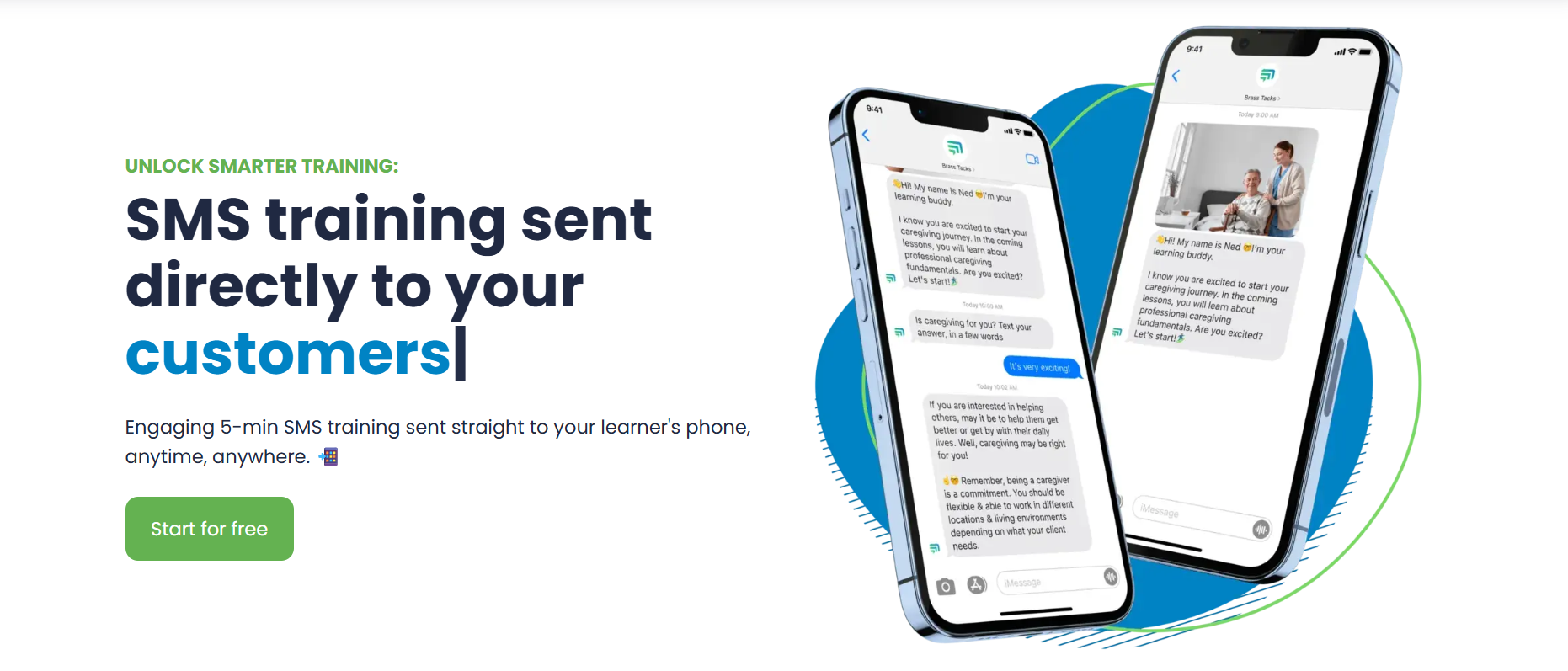
Brasstacks LMS is an AI-powered microlearning platform specifically engineered for deskless workforces. It is best for frictionless SMS-based microlearning & deskless caregivers. Moreover, it eliminates app downloads and complex portal logins by delivering 5-minute interactive training modules and quizzes directly to caregivers via text message (SMS).
AI course builder converts raw SOPs and uploaded policy documents into bite-sized microlearning lessons in minutes; automated scheduling and drip campaigns are sent to employees’ mobile devices.
It is ideal for home health aides, field nurses, and personal care assistants who spend their shifts on the move. Because learners complete training directly via SMS links without managing passwords, agencies ensure higher completion rates and better training outcomes. It is designed primarily for concise microlearning; not built for complex multi-hour video courses or advanced clinical simulation branching.
Key Features:
- AI document-to-microlearning generator (turns clinical SOPs into 5-minute text-based modules).
- Zero-friction access: No app store downloads or forgotten password support tickets.
- Automated Delivery, completion tracking, and state-compliant certification issuance.
- Access to a pre-built library of 300+ industry and compliance courses.
Pricing Model: Free plan available; paid tier starts around $9.70/learner/month with scalable enterprise options.

iSpring LMS
iSpring is an industry-standard e-learning authoring ecosystem built around a PowerPoint-based authoring tool and an enterprise LMS. Its integrated AI assistant helps training managers rapidly draft slide courses, knowledge assessments, and interactive dialogue simulations directly within a familiar interface. It is best for interactive compliance & structured clinical paths.
AI-driven generation of multiple-choice and situational quizzes directly from text prompts or uploaded documents, automated slide layout formatting, and instantaneous voiceover text-to-speech synthesis in over 40 languages.
Exceptional for formal compliance training such as annual OSHA, HIPAA, bloodborne pathogens, and medication administration, where rigid SCORM training and audit trails are required by state health authorities. Full authoring functionality requires a Windows desktop environment; mobile experience depends on the LMS player.
Key Features:
- SCORM 1.2, SCORM 2004, and xAPI exportability.
- Interactive dialogue simulation builder for comprehensive communications.
- AI-powered question generator with automated distractors and explanations.
Pricing Model: Annual subscription per author seat (starts at ~$770/author/year for iSpring Suite Max)
CogniSpark AI / eSkilled AI
CogniSpark and eSkilled AI focus on transforming dense technical documentation into structured digital learning paths. It is recommended for dedicated healthcare and clinical course building. Their authoring engines are designed to ingest structured clinical manuals, medical device guides, and operating policies. Less robust graphic customization compared to standalone design tools; requires manual review of medical terminology outputs.
Document-to-course conversion algorithms that parse multi-page clinical PDFs; automatic flashcard generation; AI-driven summary cards for quick clinical reference. It is ideal for clinical educators needing to convert 50-page nursing policy updates or wound-care manuals into 5-minute interactive micro-courses without losing critical clinical context.
Key Features:
- One-click PDF/Word ingestion for instant course structure generation.
- Built-in AI Tutor widget that can be embedded into courses to answer learner questions in real time.
- Automated scenario-based quiz creation tailored to clinical decision-making.
Pricing Model: Tiered monthly or annual SaaS subscription based on active courses and seats.
EducateMe
EducateMe leverages conversational generative AI to build immersive roleplay scenarios and adaptive coaching pathways, moving beyond static slide-deck training. It is recommended for AI roleplay and soft-skills coaching. Automated generation of conversational AI personas (e.g., an anxious family member, a confused dementia patient) with custom behavioral prompts and real-time rubric-based grading.
Unmatched for soft-skills training in elder care and home health, such as practicing de-escalation techniques, bedside manner, empathetic communication, and end-of-life care discussions. It focuses heavily on conversational learning; less optimized for pure regulatory compliance slide decks.
Key Features:
- Voice and text AI roleplay simulations with instant performance feedback.
- Automated scoring against organizational rubrics such as active listening and compliance checks.
- Adaptive learning paths that adjust difficulty based on caregiver performance.
Pricing Model: Usage-based or per-learner monthly pricing.
Synthesia
Synthesia is an AI video generation platform that turns written scripts into studio-quality training videos using realistic digital avatars and synthetic voiceovers. It converts raw text scripts into video in minutes; automatically updates video content when script text changes without needing a re-shoot; instant multi-language voice dubbing across 120+ languages.
It is excellent for visual demonstration of non-clinical and pre-clinical procedures such as proper hand hygiene, Hoyer lift operation, PPE donning/doffing, and standardized executive welcome videos for new orientation cohorts. It cannot replace hands-on clinical evaluation and requires a separate LMS/authoring tool for interspersing quizzes and interaction tracking.
Key Features:
- 140+ diverse AI avatars (including medical/healthcare attire options).
- Built-in AI script generator optimized for instructional video formats.
- Direct video embed or MP4/SCORM export options for LMS inclusion.
Pricing Model: Starter/Creator monthly plans starting around $22/month; Enterprise custom pricing for custom avatars and bulk video generation.
TalentLMS
All-in-one Learning Management System equipped with native AI content creators (TalentCraft) that allow L&D teams to draft, host, and track courses within a single platform. It is best for rapid AI microlearning & HRIS integration. It creates an instant outline based on topic prompts; automated quiz generation is interspersed within text modules; one-click formatting into responsive microlearning cards.
It is highly effective for multi-location healthcare providers requiring rapid deployment of onboarding modules with automated HRIS syncing (e.g., syncing completion data with Workday or BambooHR). However, most authoring features are tied to the host LMS, making it less flexible if you already use a separate enterprise LMS.
Key Features:
- Native AI authoring is integrated directly into the LMS administration panel.
- Automated user assignment based on job role, branch location, or certification expiration dates.
- Built-in mobile application with offline learning capabilities.
Pricing Models: Tiered pricing based on active monthly users (starts around $69-$150/month).
ChatGPT+ Articulate 360 + Canva Magic Studio
A multi-tool workflow where advanced AI models (like ChatGPT or Claude) generate instructional scripts, Canva Magic Studio builds custom visual assets, and Articulate Rise packages the content into comprehensive SCORM modules. This workflow is best for Tech-Savvy L&D teams that need maximum customization. It offers complete control over prompting, pedagogical structure, tone, visual branding, and interactive branching logic.
It is best suited for specialized healthcare systems with dedicated instructional design teams who need to build highly tailored, branded clinical academies for complex specialties. It requires more manual effort, including copy-pasting across multiple software interfaces and skilled instructional design personnel.
Key Features:
- Custom LLM prompts tailored precisely to state-specific healthcare regulations.
- Tailored visual design assets and custom branding across all modules.
- Sophisticated SCORM 2004 xAPI tracking built via Articulate Storyline
Pricing Model: Combined licensing costs of individual subscriptions (Articulate ~$1,099/year + Canva Pro + OpenAI API/Plus).
How AI Transforms Employee Development?
Implementing AI-powered course generation is not an abstract technology experiment; it delivers immediate, measurable operational value in care environments where turnover sits near 75%, and time-to-field directly impacts revenue and patient care. Below are three real-world onboarding and training scenarios demonstrating how care providers deploy AI tools to eliminate bottlenecks, maintain compliance, and improve skill retention.
Accelerated New Hire Onboarding (Compressing Weeks into Days)
Traditional caregiver onboarding involves a 5-to-7-day classroom orientation where new hires sit through long slide presentations covering policy, safety, and operational basics. With ~80% of caregiver turnover occurring within the first 90 days, that long, low-engagement ramp-up leads to early burnout, high drop-off before the first patient visit, and significant revenue loss.
The L&D team uploads the organization’s existing employee handbook, patient privacy policies, and basic care guidelines into an AI microlearning generator (such as Brasstacks LMS). The AI automatically parses the material and generates a 3-day series of 5-minute interactive mobile lessons.
New hires complete fundamental orientation modules on their smartphones via SMS or app before their first day. Clinical instructors reclaim 15-20 hours per week previously spent on lecture-style orientations, reallocating that time toward 1-on-1 practical skill checks and shadowing. Ramp time to active field deployment drops by up to 50%.
Emergency Policy & Regulatory Updates (Overnight Rollouts)
State health departments, OSHA, and the CDC regularly update clinical protocols such as revised infectious disease controls, wound care management steps, or new state reporting requirements. Converting a 30-page state regulatory PDF into a compliant, trackable training course historically required 3 to 6 weeks of manual instructional design.
Using a clinical document-to-course engine (such as CogniSpark or iSpring Suite), the clinical manager uploads the new regulatory PDF directly into the platform. Within 10 minutes, the AI generates a structured 4-slide summary module complete with situational knowledge checks, distractor answer choices, and an automated voiceover script.
The course is reviewed, edited by a clinical SME for accuracy, and deployed to all active staff within 24 hours. Field caregivers receive a mobile alert, complete the 3-minute refresher between patient visits, and provide an audit-ready compliance trail showing 100% policy acknowledgement before regulatory deadlines expire.
Soft Skills & Dementia Communication Training
Direct care staff frequently encounter emotionally charged situations such as managing dementia-related agitation, de-escalating aggressive behavior, or communicating sensitive updates to anxious family members. Standard text-based reading or multiple-choice quizzes fail to build real situational confidence or empathetic communication habits.
L&D managers use an AI roleplay generator to create conversational scenarios. The AI simulates a specific persona, for instance, a frustrated family member asking about a late medication dose, and provides adaptive voice or text responses based on the caregiver’s input.
Caregivers practice difficult conversations in a zero-stakes, private environment. The AI provides instant, objective feedback on tone, empathy, active listening, and policy adherence. Caregivers report significantly higher confidence when handling high-stress patient encounters in the field.
Quality Control, Compliance & Risk Management
While AI course generation dramatically accelerates content production, healthcare and caregiving environments operate under strict zero-tolerance conditions for clinical inaccuracies.
A hallucinated dosage instruction, an improper patient transfer technique, or an outdated infection control step can lead directly to patient harm, regulatory sanctions, or severe legal liability. Deploying generative AI in healthcare L&D requires robust governance frameworks that prioritize quality assurance, data privacy, and continuous audit readiness.
The Human-in-the-Loop (HITL) Imperative
AI tools should function as high-speed drafting assistants, handling 80% of the initial content extraction, structuring, and quiz generation while human experts perform the remaining 20% of critical review. Every AI-generated course must pass through a strict Human-in-the-Loop (HITL) validation checkpoint before deployment.
Clinical Subject Matter Experts (SMEs), Director of Nursing (DON) staff, or compliance officers must systematically review generated outputs for:
- Medical & Procedural Accuracy: Ensuring step-by-step clinical workflows strictly align with institutional SOPs and current medical standards.
- Terminology Precision: Confirming that technical terms, drug names, and diagnostic indicators have not been altered or contextually distorted by language models.
- Appropriate Assessment Options: Verifying that generated multiple-choice distractors are plausible yet unambiguously wrong, preventing misleading learning takeaways.
Data Privacy, HIPAA Compliance & LLM Architecture
Uploading internal documentation into public AI models poses significant data privacy risks. Caregiving organizations must enforce strict guidelines around content adoption:
- Zero Patient Health Information (PHI): Training materials and SOPs uploaded to AI platforms must be thoroughly vetted to ensure no real patient names, case notes, or protected health information are included.
- Closed-Loop Enterprise Models: Organizations should select AI authoring platforms that guarantee enterprise-grade data isolation, ensuring uploaded institutional knowledge is not used to train public LLM datasets or exposed to third parties.
- Vendor Security Vetting: Ensure AI course vendors comply with SOC 2 Type II standards, offer signed Business Associate Agreements (BAAs) where required, and support single sign-on (SSO) authentication.
Content Drift & Audit Readiness
State health departments, OSHA, and accreditation bodies conduct unannounced audits requiring proof of staff competency. AI authoring tools simplify maintenance by automatically flagging outdated references across entire course catalogs whenever underlying state regulations or clinical policies update. Maintaining a centralized change log, documenting which SME approved the AI draft, when it was verified, and when it was pushed to learners, ensures your organization remains completely audit-ready at all times.
Strategic Implementation Roadmap
To successfully transition your organization from traditional, high-friction course creation to an agile, AI-accelerated L&D model, training leaders should execute a phased four-step rollout plan:
- Audit & Target High-Impact Bottlenecks: Identify the top 3 training programs causing the largest onboarding delays, typically new hire orientation, annual HIPAA/OSHA compliance renewals or high-volume clinical skill updates.
- Pilot Two Complementary Tools: Conduct a 30-day proof-of-concept testing two specific platforms against a single institutional SOP. For instance, pair a mobile-first SMS generator like Brasstacks LMS with a clinical authoring engine like iSpring Suite or CogniSpark (for formal compliance).
- Establish Clinical SME Validation Protocols: Formalize a mandatory Human-in-the-Loop (HITL) review process where clinical directors verify every AI-generated lesson, script, and assessment question before field deployment.
- Integrate & Scale Across the Workforce: Sync your AI course generator with your enterprise LMS or HRIS platform to automate user enrollments, trigger push/SMS notifications, and maintain centralized, audit-ready compliance tracking.
Frequently Asked Questions (FAQs)
How does AI course creation reduce caregiver onboarding time in healthcare organizations?
AI course creation tools automate the most labor-intensive stages of instructional design, such as drafting outlines, summarizing clinical protocols, and scripting video voiceovers. Instead of spending 40 to 80 hours manually building a single training module, L&D managers can upload raw standard operating procedures (SOPs), policy manuals, or state regulatory PDFs into an AI course generator to produce structured, interactive microlearning modules in minutes.
Are AI-generated employee training courses compliant with HIPAA, OSHA, and state health regulations?
Yes, provided healthcare organizations follow a HITL governance framework and choose enterprise-grade software. AI tools generate compliance-ready course structures, interactive scenarios, and knowledge-check quizzes based directly on uploaded regulatory documents. However, to guarantee 100% regulatory compliance and audit readiness, a qualified clinical Subject Matter Expert (SME) or compliance officer must review and sign off on all AI-generated content before deployment.
Can AI training tools convert existing clinical SOPs and PDFs directly into e-learning courses?
Yes, document-to-course automation is a core capability of modern AI employee training LMS. Specialized platforms such as Brasstacks LMS and iSpring feature AI ingestion engines that parse multi-page PDFs, Word documents, and clinical manuals.
How do AI course creation tools deliver training to deskless and mobile caregivers?
Leading AI training platforms are engineered specifically for deskless, frontline workforces who do not have dedicated desktop workstations. Tools like Brasstacks LMS deliver 3-to-5 minute AI-generated microlearning modules and quizzes directly to caregivers’ mobile phones via SMS text messages, eliminating the need for app store downloads or portal logins.
What are the best AI course creation tools for healthcare and caregiving employee training?
The best AI course creation tools depend on your organization’s primary training focus. However, one of the best AI course creation tools is Brasstacks LMS. It offers text-based microlearning training for deskless field caregivers without logins so the employees can easily fit the training in their daily schedules.
Conclusion
In caregiving and healthcare delivery, time-to-competency directly dictates both operational capacity and patient outcomes. Continuing to rely on 40-to-80-hour manual instructional design workflows is no longer sustainable in an industry defined by 50%+ annual turnover and acute staffing shortages.
AI employee training course generation is not about replacing instructional designers or clinical educators; it is about liberating them from mechanical drafting tasks. By adopting AI authoring tools, care organizations can compress course development timelines by up to 80%, deliver responsive microlearning directly to deskless field staff, and ensure that every caregiver enters the field fully prepared, compliant, and confident.