

Share this
by Tee Dang Mankiewicz on Nov 1, 2026, 5:14:48 AM
Frontline workers make up around 80% of the global workforce, an astonishing 2.7 billion people spanning retail sales floors, hospital wards, and logistical hubs. Yet, despite being the backbone of the global economy and the primary touchpoint for customer experience, these deskless teams have historically received under 20% of corporate software and learning investments.
For decades, organizations have treated deskless enablement as an afterthought, relying on legacy enterprise systems designed around corporate desks, dual monitors, and dedicated calendar blocks that simply do not exist on the shop floor.
This operational neglect comes at a steep price: soaring turnover rates, recurring safety incidents, inconsistent standard operating procedure (SOP) execution, and diminished customer trust. Closing the gap requires a fundamental strategic shift. Frontline training can no longer exist as a sleepy, once-a-year compliance checkbox buried in an outdated portal. Forward-thinking leaders now treat frontline enablement as a primary operational engine that directly moves the needle on revenue, worker retention, floor safety, and enduring brand equity.
Achieving this transformation demands a unified mandate across operations and HR leadership. Training cannot remain siloed in corporate headquarters, isolated from the practical realities of daily shift work. When learning is detached from the production line or service counter, retention drops and execution falters. Enablement must live where the work actually happens, accessible in seconds, resilient to chaotic floor environments, and directly applicable to live customer or mechanical challenges.
Modern frontline employee training requires abandoning long, centralized classroom sessions in favor of agile, workflow-integrated learning. Winning organizations deliver hyper-relevant, bite-sized modules directly to mobile devices at the exact moment of need. By meeting deskless teams where they stand through purpose-built platforms like Brasstacks LMS, companies replace operational friction with clarity, transforming a distributed workforce into an agile, confident, and empowered competitive advantage.

What is Frontline Employee Training?
A frontline employee is any worker whose core responsibilities require them to be physically present on-site, shift-based, mobile, and customer- or production-facing. Unlike desk-bound professionals who operate behind corporate firewalls and personal computers, frontline talent works at the edge of the enterprise.
They are the retail associates answering shopper inquiries, warehouse pickers fulfilling orders against tight dispatch windows, machine operators calibrating assembly equipment, nurses administering bedside care, hotel attendants turning over rooms, and line cooks executing food orders during a dinner rush.
Frontline employee training is the continuous operational framework used to onboard, upskill, and support these deskless teams. Rather than a static set of orientation slides, effective frontline training combines procedural accuracy, real-time safety reinforcement, core technology fluency, and interpersonal soft skills.
It is designed to impart immediate, practical competency, ensuring every worker can execute SOPs accurately, resolve unpredictable customer or technical issues independently, and stay physically safe across dynamic, challenging environments. The fundamental disconnect in enterprise learning stems from attempting to retrofit traditional corporate training methodologies onto a deskless environment.
Knowledge workers typically learn at individual workstations, using dedicated laptops and corporate email accounts with uninterrupted calendar blocks to consume multi-module courses. However, frontline employees operate in shared, fast-moving environments using point-of-sale terminals, shared plant kiosks, or personal mobile devices. They do not have 45 minutes of quiet time to spend on an interactive slide deck; their learning takes place in two-to-three-minute pockets between customer interactions, during pre-shift team huddles, or right at the point of physical execution.
The fundamental disconnect in enterprise learning stems from attempting to force corporate methodologies onto the operational floor. While knowledge workers operate from assigned desks, dual monitors, and dedicated company email addresses, frontline workers navigate their shifts using shared point-of-sale terminals, rugged tablets, or their personal mobile devices.
Corporate staff can reserve calendar blocks for uninterrupted deep work and long-form webinars, whereas deskess staff have no desk or calendar to protect; their learning availability is squeezed into two-to-five-minute pockets between customer interactions, quick pre-shift huddles, or brief lulls in floor traffic.
Finally, enterprise systems consistently ignore the sheer friction deskless workers face just trying to log in. While corporate employees access material effortlessly through corporate intranets and Single Sign-on (SSO), frontline employees often lack corporate email credentials, must share devices with dozens of colleagues, or work in subterranean stockrooms and remote job sites with patchy connectivity.
Recognizing these physical and technological contexts fundamentally reshapes how training must be architected. When learning meets frontline workers where they actually stand, it stops being a disruptive chore and becomes an indispensable asset for impactful frontline training.
The Strategic Value of Frontline Training
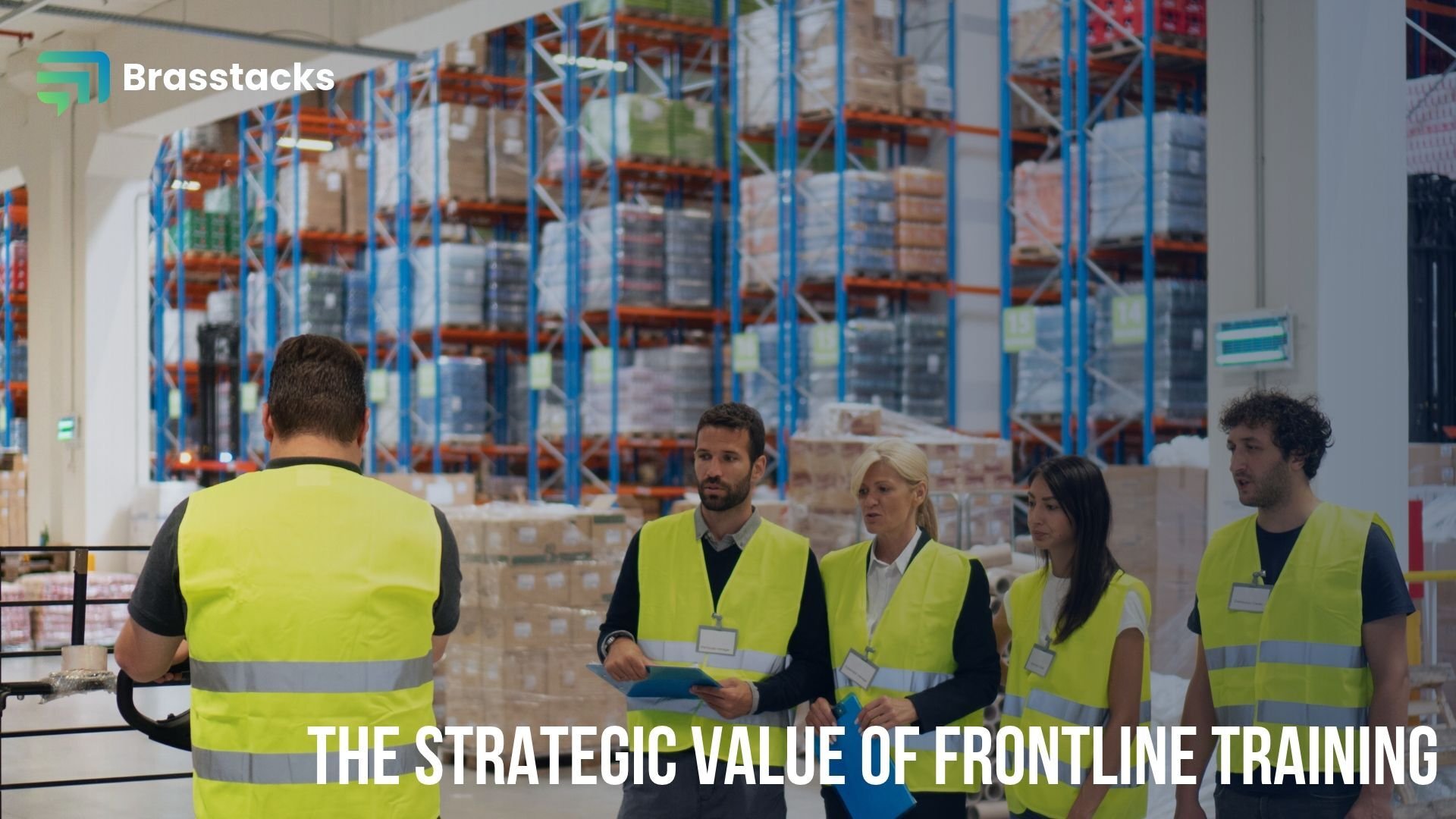
Frontline turnover averages between 40% and 60% across retail, hospitality, and logistics, costing organizations billions annually in recruitment overhead, overtime, and lost floor productivity. While compensation is often blamed, exit data consistently demonstrates that employees underperform or leave primarily when they are thrown onto the floor unprepared or feel locked into dead-end roles without a future.
Structured frontline training directly counters this churn by providing comprehensive onboarding and establishing visible internal mobility pathways, proving to workers from day one that the organization is invested in their long-term professional development. Beyond stabilizing headcount, training deskless workers serves as an enterprise’s first line of defense against catastrophic operational and compliance risks.
In manufacturing plants, distribution centers, and healthcare settings, knowledge gaps frequently manifest as serious safety hazards or costly regulatory breaches involving agencies like OSHA, FDA, HIPAA, or HACCP. Transitioning from annual compliance lectures to continuous, bite-sized refreshers keeps protocol top-of-mind, driving a measurable reduction in Lost Time Injury Frequency Rates and transforming safety practices from passive guidelines into instinctual daily actions.
Customer-facing teams represent the living embodiment of the brand promise. To a consumer, the associate at checkout, the field technician on site, or the server at the table is the entire organization. When frontline personnel lack product knowledge, service interactions feel awkward, slow, and transactional. Conversely, confident workers who master their catalog and understand customer needs deliver superior experiences that directly boost average order values, increase basket sizes, and elevate Net Promoter Scores across the board.
A well-trained frontline also delivers rapid organizational agility. When leadership needs to roll out immediate operations adjustments, launch new seasonal products, update inventory processes, or enforce crisis protocols, traditional communication channels move too slowly.
Cascading directives through regional managers and printed memos create operational lag and inconsistent execution. An integrated frontline learning system acts as a real-time operational broadcast, rolling out standardized procedures across hundreds of decentralized locations in minutes and confirming floor-level comprehension instantly.
The Core Pillars of Effective Frontline Training

Building a resilient deskless workforce requires dismantling outdated, centralized learning models and replacing them with a framework tailored specifically to the operational floor. The most successful frontline initiatives rely on six foundational pillars designed to eliminate access friction, protect floor productivity, and turn daily shift work into continuous, practical skill development.
Hyper-Personalized, Role-Relevant Learning Paths
Frontline teams are not monolithic, and broad-brush curricula inevitably lead to disengagement. A retail cashier processing returns requires a completely distinct competency model from a backroom logistics clerk or an equipment operator on an assembly line.
Modern training architectures dynamically map learning modules to precise job codes, store tiers, specialized equipment certifications, and regional regulatory mandates. As workers progress through their tenure, the system automatically adapts, transitioning them from basic orientation to continuous role upskilling and leadership readiness tracks without forcing them to rehash irrelevant material.
Mobile-First and Device-Agnostic Accessibility
As deskless teams operate on their feet rather than behind computer terminals, training content must run smoothly on whatever hardware is at hand. Platforms must be built natively for single-thumb navigation, responsive touch interfaces, and automatic offline data caching to support employees working in basements, cold storage units, or remote field sites.
For organizations leveraging BYOD (Bring Your Own Device) models, this framework requires automated shift-locking and geofencing to ensure hourly personnel cannot access training off the clock, eliminating Fair Labor Standards Act (FLSA) compliance risk.
Frictionless Onboarding and Accelerated Time to Productivity
Traditional frontline orientations often keep new hires off the floor for days, burying them in classroom lectures and policy manuals that have little bearing on physical shift execution.
Modern programs streamline this ramp-up by delivering targeted pre-boarding workflows that acclimate workers to culture, core policies, and foundational terminology before their first shift. Once on-site, practical micro-tasks paired with brief supervisor check-ins help associates achieve safe, autonomous productivity in days rather than weeks.
True Microlearning Engineered for Shift Constraints
Deskless employees operate in dynamic, fast-paced environments where uninterrupted focus is a rare luxury. Applying cognitive load theory to the shop floor requires deconstructing dense standard operating procedures into single-concept learning bursts that take two to five minutes to complete.
Swapping out cumbersome PDF binders for short, scenario-based video clps and step-by-step visual workflows allows workers to absorb critical points during natural shift lulls without compromising floor coverage.
Just-in-Time Learning in the Flow of Work
Training should not end after initial onboarding; it must function as an operational safety net directly within the workflow. When an associate encounters an unfamiliar register error code, an out-of-stock substitution rule, or an equipment breakdown, they need immediate answers, not a 30-minute course.
Affixing scannable QR codes directly to production machinery, storage bays, or point-of-sale stations allows workers to pull up instant troubleshooting workflows and standard operating procedures on demand, resolving floor bottlenecks without waiting for manager intervention.
Gamification, Social Proof, and Visible Recognition
Operating across distributed, shift-based environments can leave deskless teams feeling disconnected from the broader enterprise. Integrating shift streaks, practical competency badges, and healthy store-versus-store leaderboards taps into natural team camaraderie and engagement.
Feeding these milestones into corporate social feeds gives frontline staff visible recognition from executive leadership, transforming learning from an administrative duty into a celebrated element of daily operational culture.
Core Competencies: What Frontline Programs Must Teach

An impactful frontline training curriculum must balance immediate tactical execution with long-term behavioral readiness. Rather than overwhelming staff with abstract corporate doctrine, high-impact programs focus on five critical competency pillars. These interconnected domains ensure deskless workers operate safely, leverage modern workplace tools, delight customers, and resolve floor-level disruptions with speed, confidence, and autonomy.
Technical and Operational Proficiencies
Frontline workers must achieve absolute fluency in the everyday tools and systems that keep operations moving. In logistics and retail environments, this means mastering warehouse management systems (WMS), digital barcode scanners, and point-of-sale hardware. In industrial and technical settings, it encompasses routine machinery calibration, preventative equipment maintenance, and standardized tool handling.
Ensuring employees can mitigate minor technical glitches without idling the line or calling IT preserves productivity, protects order accuracy, and eliminates costly operational delays across every shift.
Regulatory, Environmental, Health, and Safety (EHS)
Safety training on the front line is not a theoretical compliance exercise; it directly protects human lives and organizational liability. Comprehensive EHS curricula must cover safe lifting ergonomics, slip, trip, and fall prevention.
In foodservice and healthcare, this extends to rigorous cold-chain temperature logging, sanitation schedules, and allergen containment. Continually reinforcing these practices through micro-scenarios ensures that safety measures become instinctual floor reflexes rather than forgotten rules in a binder.
Customer Interaction, Communication, and Conflict De-escalation
Customer-facing employees are the direct guardians of brand reputation, frequently interacting with shoppers and guests during high-friction moments. Frontline training must teach active listening, empathetic phrasing, and proven de-escalation techniques to defuse angry patrons and resolve disputed returns with composure.
Furthermore, as modern commerce bridges digital and physical channels, staff require specific training on omnichannel handoffs such as managing curbside pickup staging, executing BOPIS handoffs, and managing delivery driver handovers with speed and warmth.
Critical Thinking, Decentralized Problem-Solving, and Autonomy
Floor bottlenecks routinely happen when workers are forced to seek managerial sign-off for basic operational discrepancies. Modern enablement empowers frontline staff with clear guardrails to exercise autonomous judgment on the spot.
Training must guide employees on when and how to issue appeasement refunds, recommend sensible out-of-stock product substitutions, or immediately stop a malfunctioning assembly line without fear of reprimand. Cultivating this frontline agency resolves customer frustrations in seconds and safeguards minor equipment hiccups from cascading into major line shutdowns.
Emerging Leadership and Supervisor Enablement
Most frontline supervisors are promoted directly from the floor due to outstanding individual task execution, yet few receive structured training on how it actually lead people. High-impact programs deliberately build a bridge between individual contributor roles and shift leadership.
By teaching emerging team leads how to run effective pre-shift huddles, deliver constructive peer feedback, manage shift scheduling disputes, and coach struggling peers, organizations cultivate an organic talent pipeline that curbs managerial turnover and elevates team-wide morale.
People Also Read:
- Learning Strategies for Frontline Training
- 10 Ways to Overcome Frontline Training Challenges
- 10 Best LMS for Frontline Training Workers
- How to Train Frontline Workers without an App
- Mobile Learning for Frontline Workers
How to overcome the Structural Roadblocks in Frontline Training?

Enrolling frontline workers in learning programs sounds straightforward in theory, but operational realities frequently derail traditional L&D strategies. From intricate labor laws and shifting schedules to absent hardware and language barriers, training initiatives collapse when they fail to accommodate ground constraints. Overcoming these entrenched operational hurdles requires purpose-built solutions designed specifically for the physical workplace.
The “No Desk, No Corporate Email” Dilemma
Unlike corporate staff who rely on Active Directory and company inboxes, most frontline associates do not possess corporate email addresses or dedicated workstations. Forcing these workers through a conventional single sign-on portal creates immediate login friction, leading to abandoned sessions and uncompleted compliance mandates.
Modern learning platforms overcome this by offering email-free authentication methods, including one-time SMS verification codes, phone-number sign-ins, magic links, or scannable personal QR badges that instantly launch verified learning sessions on shared floor terminals or mobile devices.
Severe Time Poverty and Shift Pressures
Frontline teams juggle continuous operational demands, leaving zero margin for extended classroom training or hour-long webinars during a busy shift. When learning is treated as a separate, off-floor activity, floor managers resist releasing staff, and completion rates plummet.
The solution is shift-integrated learning: deconstructing coursework into three-minute modules that seamlessly fit into daily team rhythms. Embedding quick learning drills into pre-shift morning huddles or positioning micro-refreshers during natural floor lulls ensures consistent skill building without compromising staffing levels.
Wage and Hour Labor Law Compliance (FLSA)
For hourly workers, mandatory training completed outside scheduled shift hours triggers severe wage-and-hour liability under the Fair Labor Standards Act (FLSA), exposing organizations to unpaid overtime penalties and legal exposure. To mitigate this operational risk, advanced frontline platforms incorporate strict automated controls.
By pairing geofencing technology with time-clock integration, the system enforces automated shift locks that prevent hourly staff from launching learning content whenever they are clocked out or away from the physical facility.
Exceptional Linguistic and Literary Diversity
Frontline workforces are exceptionally diverse, often bringing varied reading levels and non-native language fluencies to the floor. Traditional, text-heavy training binders and dense policy documents fail to engage these learners and regularly lead to procedural misunderstandings.
Modern programs solve this barrier by prioritizing video-first instructions: clear iconography, visual step-by-step checklists, and automated multi-language captions. Instant, localized translation ensures every employee masters standard operating procedures, regardless of primary language or literacy level.
Remote, Multi-Unit Execution
Maintaining uniform service and production standards across dozens or hundreds of franchised locations and regional sites is notoriously challenging. Local managers often introduce rogue workarounds, diluting brand consistency and operational safety.
Organizations combat this drift by deploying centralized authoring workflows equipped with controlled local variance toggles. This approach preserves core brand and safety standards universally across all business units while allowing regional supervisors to tailor hyper-local protocols, such as municipal waste disposal laws or regional supplier handoffs.

The Modern Frontline Training Tech Stack
Traditional enterprise Learning Management Systems (LMS) were architected for a corporate reality that does not exist on the frontline. Built around desktop web browsers, monolithic SCORM packages, long seat-time compliance tracking, and corporate domain networks, legacy platforms assume an employee sitting at a desk with continuous connectivity and dedicated study hours.
For deskless teams, this infrastructure is a non-starter. Forgotten enterprise passwords create instant drop-off, desktop-optimized layouts fail on mobile screens, and multi-gigabyte browser loads crash on weak shop-floor Wi-Fi. The outcome is predictable: low engagement, falsified completion tracking by frustrated managers, and critical knowledge failing to reach the floor.
What Frontline Operations Actually Need
Operational environments require an entirely different technology philosophy. Deskless workers need lightweight, native iOS and Android experiences optimized for sub-second load times and intuitive, single-thumb navigation.
Frontline technology must function as an operational utility rather than an academic portal: providing offline video playback, intuitive tap-through checklists, and streamlined search interfaces that surface answers in seconds. If an application takes more than ten seconds to authenticate and display relevant guidance, it is operationally useless during a fast-moving shift.
The Brasstacks LMS Differentiator
Brasstacks LMS bridges this operational gap by reimagining workforce enablement from the floor up, combining modern mobile UX with enterprise-grade operational controls:
- Unified Knowledge + Training: Rather than siloing structured courses in an LMS and operational guides in a company intranet, brasstacks unifies formal training tracks with an instant-access, searchable knowledge base within a single, lightweight interface.
- Rapid Micro-Authoring: Floor realities evolve faster than corporate instructional design cycles can handle. Brasstacks empowers shift managers and operational leads to capture, trim, and publish 60-second video SOPs directly from mobile devices, establishing standard practices in minutes.
- Granular Role and Site Provisioning: Automated permissioning assigns targeted modules based on individual store location, department, job role, and shift pattern, ensuring workers only encounter content personalized to their roles.
- True Offline Synchronization: Critical operations often run in connectivity dead zones, including subterranean warehouses, metal-shielded stockrooms, and remote field sites. Brasstacks LMS automatically pre-caches key modules and syncs progress once the device reconnects to a network.
How to Build and Roll Out a Frontline Training Program?
Transitioning an organization from legacy desktop training to an agile frontline enablement model is an operational rollout, not merely a software deployment. Successfully scaling a program across dispersed locations requires structured execution that respects shift constraints, empowers floor leadership, and proves tangible business value before enterprise-wide launch.
Phase 1: Needs Analysis and Thorough Observation
Effective training design begins on the shop floor, not inside a corporate conference room. Program leaders must physically shadow workers across typical shifts to identify operational friction points, undocumented workarounds, and common procedural bottlenecks.
During this phase, teams audit error-prone standard operating procedures, observe peak customer or production windows, and map the precise micro-moments when workers actually have two to five minutes of downtime. Capturing authentic floor constraints early prevents the development of idealistic content that fails to survive a real-world shift.
Phase 2: Content Rationalization and Micro-Chunking
Most enterprises possess extensive, outdated training repositories dominated by dense policy manuals, sixty-page binders, and compliance slide decks. Phase two requires aggressive content triage using the 80/20 rule: identify the top 20% of skills, checklists, and troubleshooting steps that resolve 80% of daily operational errors.
These critical topics are then deconstructed into standalone, micro-learning assets consisting of two-to-three-minute video workflows, visual job aids, and scenario-based assessments designed for rapid retention and immediate on-shift execution.
Phase 3: Platform Architecture and Pilot Testing
Before scaling across an entire footprint, deploy Brasstacks LMS within a controlled testing cohort; typically two to three representative stores, branches, or distribution units. This phase tests baseline technical performance, including mobile authentication speed and offline synchronization in low-connectivity areas, and automated shift-lock compliance controls.
More importantly, it provides a feedback channel for floor workers and shift supervisors to critique interface usability, module clarity, and whether learning assignments disrupt active workflows.
Phase 4: Multi-Site Phased Rollout and Manager Enablement
The long-term success of any frontline initiative hinges on shift supervisors and floor managers. If managers view training as an operational distraction, completion rates will collapse. Before launching company-wide, train shift leads on how to incorporate micro-learning into morning huddles, review team completion dashboards, and use in-app micro-authoring tools to document local workflows. Once leadership is aligned, launch the platform enterprise-wide, leveraging onboarding streaks and friendly store-versus-store leaderboards to build early user adoption.
Phase 5: Continuous Optimization and Feedback Loops
Frontline training is never static; operational procedures, product catalogs, and safety requirements continually shift. Establish recurring review cycles where learning metrics are analyzed against floor data to identify emerging knowledge gaps. In-module star ratings, employee comment feeds, and supervisor check-ins allow operational leads to update outdated modules in minutes, ensuring the frontline repository remains an accurate reflection of daily floor reality.
Measurement, Analytics, and Proving ROI
For decades, learning and development leaders have defended training budgets using vanity metrics like course completions, total hours logged, and aggregate quiz scores. To an Operations Director, Plant Manager, or Chief Financial Officer, these numbers convey activity, not value.
High quiz scores do not prevent floor safety incidents, and 100% compliance completion rates mean little if inventory shrink continues to rise and customer satisfaction fails. To safeguard executive investment, frontline enablement must abandon surface-level engagement metrics and connect learning activity directly to operational performance.
The Frontline L&D Metric Hierarchy
Demonstrating credible business return requires evaluating frontline programs through a multi-tiered framework tailored to deskless operations. At the foundation sits Level 1: Engagement and Adoption, tracking practical usage signals such as shift login frequency, microlearning completion velocity, and on-shift search queries for standard operating procedures.
Moving up, Level 2: Skill Acquisition captures verified competency through timed scenario simulations and digital supervisor sign-offs. Level 3: Operational Behavior measures observable floor impact, such as speed to first customer greeting, task execution accuracy, and material scrap reductions. At the summit, Level 4: Business Impact ties enablement directly to top-level organizational KPIs, including frontline retention rates, overall OSHA safety records, Customer Net Promoter Scores (NPS), and operating margin.
Connecting Training Data to Operational Telemetry
The true value of a platform like Brasstacks LMS emerges when learning data is integrated with floor telemetry and business systems. Rather than viewing training analytics in isolation, operations leaders cross-reference micro-module completion across specific locations against hard operational data.
In retail environments, high completion of cash-management drills correlates directly with fewer till discrepancies and faster checkout times. In hospitality, beverage and menu-prep micro-modules show a direct link to improved table turnover and reduced order modifications.
In manufacturing, completing preventative equipment maintenance walkthroughs produces measurable drops in machine downtime and product defect rates. Furthermore, tracking employee retention differentials reveals that frontline cohorts actively engaged in continuous microlearning demonstrate significantly higher 90-day retention rates, directly cutting the steep recruiting and onboarding overhead associated with constant frontline turnover.
Frequently Asked Questions about Frontline Training
How is frontline employee training different from corporate training?
Corporate training typically serves desk-based knowledge workers with dedicated laptops, email inboxes, and calendar blocks for lengthy, abstract coursework. Frontline employee training targets deskless, mobile, and shift-based workers who operate on the floor. It relies on mobile-first microlearning, bite-sized standard operating procedures (SOPs), and visual job aids consumed in 2-to-5-minute intervals directly within the daily flow of work.
How do we prevent wage-and-hour (FLSA) violations when using mobile training?
For hourly, non-exempt workers, completing training off the clock creates severe legal liability under the Fair Labor Standards Act. Modern platforms resolve this by integrating with time-and-attendance systems and applying geofencing controls. These features enforce automated “shift locks,” restricting module access exclusively to times when the employee is physically clocked in at their worksite.
How can we train frontline staff who do not have corporate email addresses?
Most deskless workers lack company email credentials, which stalls traditional SSO logins. Modern frontline platforms bypass this hurdle with email-free authentication methods, including one-time SMS verification codes, phone-number sign-ins, magic links, and scannable personal QR badges that securely launch verified learning sessions on shared terminals or mobile devices.
What is the best way to measure the return on investment of frontline training?
Effective measurement moves past vanity metrics like quiz scores and course completions. True ROI connects training completions to operational floor telemetry, tracking reductions in Lost Time Injury Frequency Rates (LTIFR), drops in retail cash-register discrepancies, lower manufacturing scrap rates, faster table turnover in hospitality, and higher 90-day frontline retention rates.
Future Recommendations
The integration of generative and conversational AI is transforming frontline enablement from scheduled training into instantaneous, voice-activated support. Rather than stopping work to search through complex digital libraries, associates equipped with wearable headsets or mobile devices can ask spoken questions in natural language. The AI parses the query against approved company manuals, instantly feeding concise, step-by-step SOP summaries and troubleshooting steps directly to the worker in real time.
Augmented reality is rapidly moving from pilot stages to everyday floor deployment. By projecting interactive visual overlays onto physical environments, AR guides field technicians through intricate mechanical assemblies, highlights exact component replacements, and maps optimal pick-and-pack navigation paths inside massive fulfillment centers. This spatial instruction removes guesswork, slashes error rates, and accelerates operational precision without requiring hands to leave the machinery.
Equipping frontline workers is not an administrative HR expense; it is a primary operational lever for enterprise scalability, frontline resilience, and customer satisfaction. Deskless teams dictate the quality of daily execution, brand perception, and safety performance.
Transforming frontline operations begins by replacing outdated, desktop-era software with a mobile-first, workflow-integrated learning platform. Schedule a Brasstacks LMS demo today to empower your deskless workforce with the exact knowledge they need, right where the work happens.